
Car losing power with no obvious problem? Learn how mechanics diagnose airflow, fuel, ignition, sensor, vacuum leak, turbo and transmission issues.
Your car still starts normally. There are no strange noises, no smoke from the exhaust, and perhaps no warning light on the dashboard. But something doesn’t feel right.
You press the accelerator and the car feels slower than before. Overtaking requires more effort. Acceleration feels flat, or the vehicle simply doesn’t respond as quickly as you remember.
When a car is losing power but shows no obvious problem, finding the cause isn’t always as simple as opening the bonnet and looking for a damaged part.
Modern vehicles rely on a combination of airflow, fuel delivery, ignition, sensors, electronics, exhaust systems, and—in turbocharged vehicles—boost pressure. A fault in any of these areas can affect performance without producing an obvious visual clue.
So how does a mechanic actually find the problem?
Let’s walk through the diagnostic process.
What Does “Losing Power” Actually Feel Like?
Power loss doesn’t feel exactly the same in every vehicle.
Drivers commonly describe it as:
- Slow acceleration
- Delayed response when pressing the accelerator
- Difficulty overtaking
- Poor performance when driving uphill
- Jerking or hesitation under acceleration
- Engine RPM increasing without the expected acceleration
- Vehicle feeling unusually “heavy”
- Reduced performance when the AC is operating
- Normal city driving but poor performance at highway speeds
These details matter.
A car that loses power only during hard acceleration may have a different problem from one that feels sluggish all the time.
That is why good diagnosis often starts with a simple question:
When exactly does the car lose power?
Why Can a Car Lose Power Without a Warning Light?
Drivers often assume that a serious engine problem will automatically trigger the Check Engine Light.
That isn’t always the case.
Some faults may remain within the vehicle computer’s acceptable range even though performance has started to deteriorate. A component can also become contaminated or weakened without immediately generating a diagnostic trouble code.
For example, DENSO notes that a contaminated Mass Air Flow sensor can cause poor drivability and hesitation, and in some circumstances the engine may run poorly without setting a diagnostic trouble code.
This is why no warning light does not necessarily mean no problem.
Step 1: Understanding When the Power Loss Happens
Before connecting diagnostic equipment, an experienced technician needs to understand the driver’s complaint.
Questions may include:
- Does it happen when the engine is cold or warm?
- Does it happen only during hard acceleration?
- Is it worse when the AC is on?
- Does it happen at highway speeds?
- Does the engine hesitate or simply feel slow?
- Has fuel consumption increased?
- Does the vehicle vibrate or jerk?
- Has the Check Engine Light appeared recently?
- Did the problem begin suddenly or gradually?
These details help narrow down which systems need investigation.
A road test may also be useful when it can be carried out safely.
Step 2: Scanning the Vehicle’s Computer
The next step may involve connecting professional diagnostic equipment to the vehicle.
Modern diagnostic tools can retrieve information from the vehicle’s electronic control systems, including stored fault codes and live operating data. Bosch’s professional diagnostic systems, for example, support fault-memory readout, actual-value monitoring and additional troubleshooting functions.
But there is an important distinction:
A diagnostic scan provides clues. It doesn’t automatically provide the final diagnosis. If the scanner reports a fault involving the air-fuel mixture, for example, the underlying cause could involve an air leak, fuel-delivery issue, sensor problem, wiring fault, or another condition.
Replacing whatever component appears in a fault-code description can result in unnecessary repairs.
Step 3: Checking Whether the Engine Is Getting Enough Air
Your engine needs the correct amount of air for efficient combustion.
Problems in the air-intake system can make a vehicle feel sluggish or hesitant.
A technician may inspect:
- Engine air filter
- Intake hoses
- Mass Air Flow sensor
- MAP sensor
- Throttle body
- Intake connections
- Vacuum hoses
A restricted air filter can reduce airflow, while inaccurate sensor readings can affect how the engine computer calculates fuel delivery.
Bosch identifies sluggish acceleration as one possible symptom associated with a clogged or failing air-mass sensor.
DENSO similarly lists hesitation during acceleration and poor drivability among symptoms associated with MAF sensor problems.
Step 4: Looking for Hidden Air or Vacuum Leaks
Sometimes everything looks normal during a visual inspection. But a small crack in an intake hose, gasket, vacuum line, or connection can allow unwanted air into the engine.
This can affect the air-fuel mixture and potentially lead to:
- Hesitation
- Rough idle
- Reduced power
- Increased fuel consumption
- Check Engine Light
- Unstable engine operation
DENSO notes that vacuum leaks in intake-manifold systems can interfere with MAP-sensor operation and can be associated with loss of engine power and hesitation.
How does a mechanic find a leak that can’t be seen?
This is where smoke test diagnostics can become useful.
Controlled smoke can be introduced into an appropriate closed system. If smoke escapes from somewhere it shouldn’t, technicians can locate leaks that may be difficult to identify visually. Bosch describes smoke-based diagnostic equipment as a method for locating leaks in systems including intake and exhaust circuits.
This is one reason a vehicle can lose power even though nothing appears obviously broken when you open the bonnet.
Step 5: Checking Fuel Delivery
An engine also needs the correct quantity of fuel at the correct pressure.
If fuel delivery becomes insufficient or inconsistent, the problem may become most noticeable when you demand more power.
For example, the car might drive reasonably well at low speed but hesitate when:
- Accelerating hard
- Joining a highway
- Overtaking
- Driving uphill
Depending on the vehicle, technicians may investigate areas such as:
- Fuel pressure
- Fuel pump operation
- Fuel injectors
- Fuel-delivery control
- Relevant sensors
Bosch notes that inconsistent fuel delivery can contribute to poor performance and slow throttle response, while irregular fuel pressure can produce uneven engine performance.
Step 6: Checking for an Engine Misfire
Sometimes “loss of power” is actually an engine misfire.
A misfire means combustion isn’t occurring correctly in one or more cylinders.
Potential causes can include:
- Worn spark plugs
- Faulty ignition coils
- Fuel injector problems
- Air or vacuum leaks
- Sensor faults
- Mechanical engine problems
A severe misfire may make the engine shake noticeably.
But a mild or intermittent misfire can be more difficult for the driver to recognise. You may simply notice that the vehicle feels less responsive than before.
Diagnostic data can help identify whether one or more cylinders are behaving abnormally, after which the technician can test the relevant systems.
Step 7: Checking Engine Sensors and Live Data
This is where diagnosing modern vehicles becomes very different from simply replacing mechanical parts.
The engine computer relies on multiple sensors to understand what is happening.
Depending on the vehicle, these can include sensors monitoring:
- Airflow
- Intake pressure
- Oxygen content
- Engine temperature
- Crankshaft position
- Camshaft position
- Throttle position
- Boost pressure
A sensor doesn’t necessarily have to fail completely to create drivability problems.
For example, DENSO identifies intermittent power loss, inconsistent acceleration and misfiring among potential symptoms associated with camshaft or crankshaft sensor problems.
Rather than looking only for a warning light, technicians can examine live data to see whether sensor readings make sense while the engine is operating.
Step 8: Checking Turbo and Boost Performance
If your vehicle has a turbocharged engine, the boost system becomes another area to investigate.
A turbocharged car may still drive normally at low speeds but feel noticeably weaker when you ask for stronger acceleration.
Potential areas requiring inspection can include:
- Boost hoses
- Intercooler connections
- Air leaks
- Turbocharger operation
- Boost-control components
- Relevant sensors
Even a relatively small boost leak may reduce performance without creating dramatic smoke or noise.
This is particularly relevant to many modern European, premium, and performance vehicles that use turbocharged engines.
Step 9: Checking Whether the Exhaust Is Restricting the Engine
An engine must not only breathe in—it must also expel exhaust gases efficiently.
Problems involving exhaust components can sometimes restrict flow and reduce engine performance.
A technician may investigate the exhaust system when the vehicle:
- Feels increasingly weak at higher RPM
- Struggles under load
- Has unusual exhaust behaviour
- Shows relevant diagnostic readings or fault codes
The exact testing procedure depends on the vehicle and symptoms.
Again, diagnosis should come before replacing expensive exhaust components. There are several possible causes of car engine misfiring, including ignition, fuel-delivery and airflow problems, and identifying the actual cause is important before replacing components.
Step 10: Considering the Transmission
Not every car that “feels underpowered” actually has an engine problem. Sometimes the engine is producing power normally, but the transmission isn’t delivering it effectively to the wheels.
Drivers may notice:
- Engine RPM rising without matching acceleration
- Delayed gear changes
- Jerking during shifts
- Gear slipping
- Poor response when accelerating
- Unusual transmission behaviour
This is why a technician needs to determine whether the problem originates from the engine, transmission, or another drivetrain component before recommending repairs.
Why Guessing Can Become Expensive

Imagine a car feels sluggish.
It would be easy to assume:
“The spark plugs probably need changing.”
But what if the actual problem is a hidden intake leak?
Or the driver assumes:
“The turbo must be failing.”
But the real problem is a loose boost hose. Or a fault code mentions an oxygen sensor, so the sensor is replaced—while the real cause is an air leak affecting the mixture. Modern vehicle diagnosis is about testing a theory before replacing a component.
That can prevent unnecessary parts replacement and help identify the actual root cause.
Why Power Loss Can Be More Noticeable in Dubai
Dubai driving conditions can make an existing performance problem easier to notice.
Vehicles regularly operate with:
- High ambient temperatures
- Continuous AC use
- Long periods of idling
- Stop-start traffic
- High-speed highway driving
- Dust exposure
For example, a vehicle with a developing airflow, cooling, ignition, or fuel-delivery issue may feel acceptable during light driving but struggle when additional power is required.
Heat itself shouldn’t automatically be blamed for power loss. The underlying system still needs to be diagnosed.
When Should You Get a Loss of Power Checked?
Arrange an inspection if you notice a consistent change in how your vehicle performs, particularly if:
- Acceleration has become noticeably slower
- The car hesitates during overtaking
- The engine jerks under acceleration
- Fuel consumption has increased
- The engine runs roughly
- The Check Engine Light appears
- Performance becomes poor at highway speeds
- The problem is progressively getting worse
Seek more urgent assistance if:
- The Check Engine Light is flashing
- The engine is severely shaking
- The vehicle is overheating
- An oil-pressure warning appears
- There is heavy smoke
- The vehicle suddenly loses substantial power
- The car enters a reduced-power or limp mode
Continuing to drive with a serious fault can potentially cause additional damage.
Good Diagnostics Is More Than Reading a Fault Code
Modern diagnostic equipment is extremely useful, but the scanner is only one part of the process.
Professional diagnosis may combine:
Driver symptoms → visual inspection → diagnostic scan → live data → road test → system-specific testing → leak testing → mechanical inspection → confirmed diagnosis
Bosch notes that modern powertrain systems combine electronics and complex system architecture, making structured diagnosis and interpretation of vehicle complaints an important workshop skill.
That is why two cars with the same symptom—”my car has lost power”—may ultimately need completely different repairs.
Don’t Wait Until a Small Performance Change Becomes a Breakdown
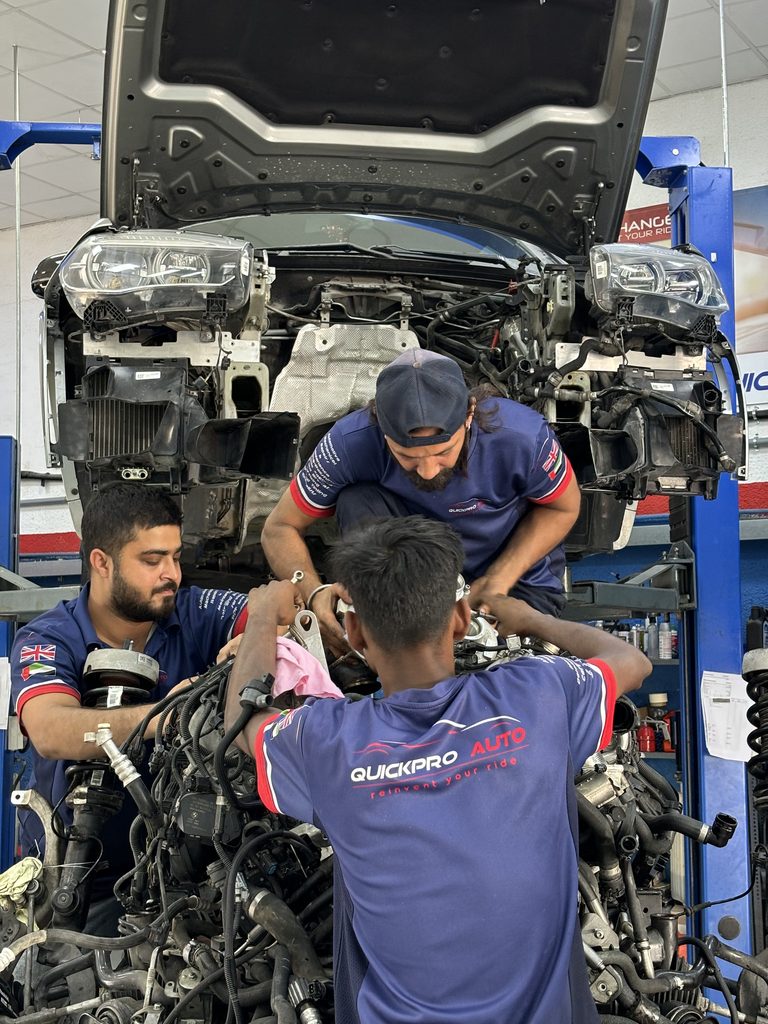
If your car doesn’t accelerate the way it used to, don’t wait for a warning light or breakdown before having it checked.
A loss of power can originate from something relatively straightforward, such as an airflow problem, or from a more complex issue involving fuel delivery, ignition, sensors, turbocharging, transmission, or engine management.
The important part is finding the actual cause.
At QuickPro Auto Services, we diagnose engine-performance and drivability problems using professional diagnostic procedures. Our technicians inspect the relevant mechanical and electronic systems before recommending repairs, helping identify the root cause rather than replacing parts based on assumptions.
We work on everyday cars, family vehicles, SUVs, and premium and performance vehicles.
QuickPro Auto Services – Al Quoz 3, Dubai
Call: 056 805 6000
Is Your Car Feeling Slower Than Usual?
Don’t wait until a small hesitation becomes a bigger performance problem. Visit QuickPro Auto Services in Al Quoz 3 for professional vehicle diagnostics and engine-performance inspection.