Car pulling to one side? Learn whether wheel alignment, tyre pressure, brakes, steering or suspension could be causing it and when to get it checked.
You’re driving on a straight road, but the car seems to keep drifting left or right. You correct the steering, and a few seconds later, you’re doing it again.
The first thought for many drivers is:
“My car needs a wheel alignment.”
It might. But a car pulling to one side isn’t always caused by wheel alignment.
Different tyre pressures, uneven tyre wear, steering or suspension problems, and even a dragging brake can all create a similar feeling. Manufacturers and tyre specialists also recommend checking tyres and other mechanical causes before assuming alignment is responsible.
The most useful clue is often when the pulling happens.
Does it happen all the time? Only when braking? During acceleration? Or has it appeared after changing your tyres?
Here’s how to understand what your car may be telling you.
What Does It Mean When a Car Is “Pulling” to One Side?
A genuine pull means the vehicle consistently wants to move left or right instead of tracking straight, requiring you to keep correcting the steering.
You might notice:
- The vehicle consistently moves towards one side
- You need to maintain steering pressure to keep straight
- The steering wheel doesn’t feel centred
- One side of the tyres is wearing faster
- The pull becomes stronger while braking
- The behaviour changes during acceleration
But before assuming something is wrong, there is another factor to consider.
Could It Just Be the Road?
Roads are not always completely flat. Many have a slight slope or camber to help with drainage.
That can cause a mild tendency for a vehicle to drift towards one side. Michelin notes that road camber can influence vehicle direction; a consistent pull regardless of road surface is more suggestive of a vehicle-related problem
If you constantly have to fight the steering to stay straight, however, the car should be inspected.
1. Incorrect Tyre Pressure — Check This First
One of the simplest causes can also be one of the easiest to overlook.
If the pressure in one tyre is significantly different from the tyre on the opposite side, the difference in rolling behaviour can contribute to the vehicle pulling.
Before booking an alignment, check all four tyres when cold and compare the pressures with the specification provided by your vehicle manufacturer, usually found on the vehicle placard or owner’s manual.
Do not simply inflate every vehicle to the same generic PSI figure.
The correct pressure depends on the vehicle, tyre specification and load requirements.
Michelin identifies unequal tyre pressure as one potential cause of a vehicle pulling to one side.
What if the tyre keeps losing pressure?
If you correct the pressure but the same tyre becomes low again, don’t keep topping it up indefinitely.
There could be:
- A puncture
- Valve leakage
- Wheel/rim sealing problem
- Tyre damage
Have the tyre inspected.
2. Wheel Alignment — A Common Cause, but Not the Only One
Wheel alignment refers to the angles at which your wheels sit relative to the vehicle and road.
When these angles are outside the manufacturer’s specifications, you may notice changes in handling and tyre wear.
Possible signs include:
- Car pulling left or right
- Steering wheel sitting off-centre
- Uneven tyre wear
- Vehicle not tracking straight
Correct alignment is important both for predictable steering and even tyre wear. Michelin lists pulling and uneven tyre wear among indicators that alignment should be inspected. Michelin Canada
But here’s the important part:
Don’t assume every pull needs an alignment.
Toyota’s technical guidance on diagnosing vehicle pull specifically recommends checking tyre pressure, tyre condition, impact damage, suspension/steering components and brake drag before concluding that alignment is the cause.
If another component is worn or damaged, simply adjusting the alignment may not solve the underlying problem.
3. Uneven or Damaged Tyres Can Make the Car Pull
Your tyres don’t necessarily wear at exactly the same rate.
If one tyre has significantly different tread wear, construction, damage, or characteristics from the tyre opposite it, the vehicle’s behaviour may change.
Look for:
- Uneven tread depth
- Excessive inner-edge wear
- Excessive outer-edge wear
- Irregular or patchy wear
- Visible tyre damage
- Different tyre sizes or unsuitable tyre combinations
Sometimes the tyre itself can even contribute to directional pull despite apparently correct alignment. This is one reason professional diagnosis should consider tyres and alignment together, rather than treating them as completely separate issues. Understanding the common causes of tyre wear in Dubaintify how incorrect tyre pressure, alignment problems and worn suspension components contribute to uneven tyre wear and vehicle handling issues.
4. What If the Car Pulls Only When You Brake?
This is an important distinction.
If your car drives relatively straight normally but suddenly pulls left or right when you press the brake pedal, the problem may be related to the braking system rather than wheel alignment.
One possible cause is a sticking or dragging brake caliper.
A brake on one side may apply or release differently from the other side, creating unequal braking force and causing the vehicle to move towards one side.
Official Nissan parts guidance, for example, identifies a stuck caliper as one potential cause of a vehicle pulling during braking.
Other brake-related conditions can also contribute, so the brakes need to be inspected rather than diagnosing the caliper from the symptom alone.
Watch for additional clues
You may also notice:
- Pulling becomes much stronger while braking
- Unusual brake smell
- One wheel becoming unusually hot
- Reduced braking performance
- Brake vibration
- Unusual brake noises
A vehicle pulling strongly under braking is a safety concern.
Have it inspected promptly rather than simply booking a wheel alignment.
5. Worn Steering Components Can Affect How the Car Tracks
Your steering system contains multiple components that help control wheel direction.
As these components wear, excessive movement can develop.
Depending on the vehicle, technicians may inspect components such as:
- Tie rod ends
- Steering linkage
- Ball joints
- Steering rack components
- Relevant bushes and joints
A worn tie rod end, for example, can affect steering precision and alignment stability. Recognising the early signs of tie rod end problems can help drivers understand why loose steering, uneven tyre wear and difficulty maintaining alignment should not be ignored.
Possible symptoms may include:
- Loose or vague steering
- Uneven tyre wear
- Knocking or clunking
- Steering vibration
- Difficulty maintaining alignment
- Changes in vehicle tracking
A proper steering inspection is particularly important if an alignment has already been performed but the problem keeps returning.
6. Suspension Problems Can Also Cause Pulling
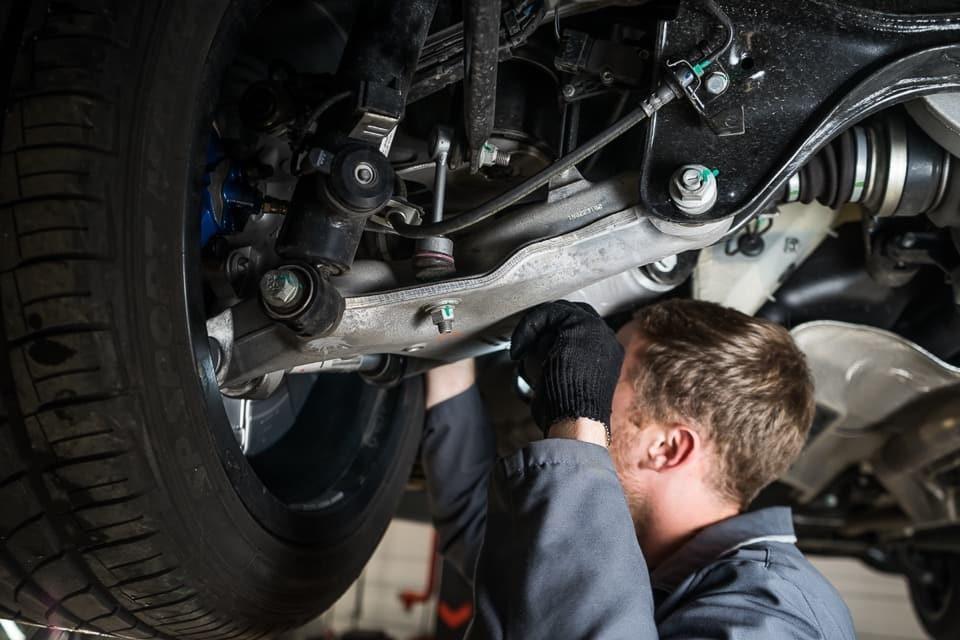
The suspension does much more than make the ride comfortable.
It helps maintain the position and contact of the wheels relative to the road.
Depending on the vehicle design, worn or damaged components such as control-arm bushes, ball joints, springs or other suspension parts can affect wheel geometry and handling.
This can result in:
- Pulling
- Uneven tyre wear
- Poor steering response
- Instability
- Unusual noises
- Difficulty maintaining correct alignment
If a suspension component is worn, repeatedly performing wheel alignment without repairing the component may not solve the underlying problem.
7. What If the Car Started Pulling After New Tyres?
This deserves attention because drivers sometimes experience pulling immediately after tyre replacement.
Before assuming the alignment has suddenly failed, technicians may check:
- Tyre pressures
- Correct tyre sizes
- Installation
- Tread differences
- Tyre condition
- Wheel condition
- Alignment
There are also less common situations where characteristics of an individual tyre can contribute to directional pull.
Toyota’s technical guidance specifically warns that tyre-generated lateral force can sometimes be mistaken for an alignment problem
If the pulling started immediately after replacing or rotating tyres, tell the technician. That timing is diagnostically useful.
Does Wheel Balancing Fix a Car Pulling to One Side?
Usually, wheel balancing and wheel alignment address different problems.
Wheel balancing deals with how mass is distributed around the tyre-and-wheel assembly.
An imbalance is more commonly associated with symptoms such as:
- Steering-wheel vibration
- Vibration at particular speeds
- Seat or floor vibration
Alignment concerns the direction and angles of the wheels.
Therefore, if your main complaint is a consistent directional pull, simply balancing the wheels may not solve it.
However, tyres, wheels, alignment and suspension interact, so technicians should diagnose the actual symptom rather than selecting a service based only on assumptions.
Why Are My Tyres Wearing Unevenly at the Same Time?
This is an important clue.
If the car pulls and you also notice unusual tyre wear, there may be an alignment, tyre, steering or suspension issue affecting how the tyre contacts the road.
For example:
Inner-edge wear
Can be associated with alignment geometry or worn components.
Outer-edge wear
Can have several causes, including alignment and tyre-pressure-related conditions.
One tyre wearing differently from the others
Needs further inspection rather than assuming all four tyres have the same problem.
Do not use the wear pattern alone to diagnose a failed component. Treat it as evidence that helps guide the inspection.
Why Does My Car Pull Only During Acceleration?
This is different again.
If the steering feels normal while cruising but pulls or tugs when you accelerate strongly, the technician needs to know that.
Depending on the vehicle, possible areas to investigate can include:
- Tyres
- Suspension
- Steering components
- Wheel alignment
- Drivetrain behaviour
Some front-wheel-drive vehicles can also exhibit torque steer, particularly under strong acceleration. This is a tendency for steering to pull under power and can vary significantly between vehicle designs. Haynes Manuals North America
A new or increasingly severe pull should still be inspected rather than automatically dismissed as normal vehicle behaviour.
How Do Mechanics Diagnose a Car Pulling to One Side?
This is where diagnosis becomes more useful than simply requesting “an alignment.”
At QuickPro, the appropriate inspection depends on the symptoms and vehicle, but the diagnostic process can include:
1. Understanding when it happens
Does the vehicle pull constantly, while braking, under acceleration or only at certain speeds?
2. Checking tyre pressures
Incorrect or unequal pressures are identified before more complex work is considered.
3. Inspecting the tyres
Technicians look for uneven wear, damage, tread differences and other abnormalities.
4. Inspecting steering and suspension components
Worn components can affect wheel position and steering behaviour.
5. Checking the braking system where relevant
If the vehicle pulls while braking, the brakes require particular attention.
6. Checking wheel alignment
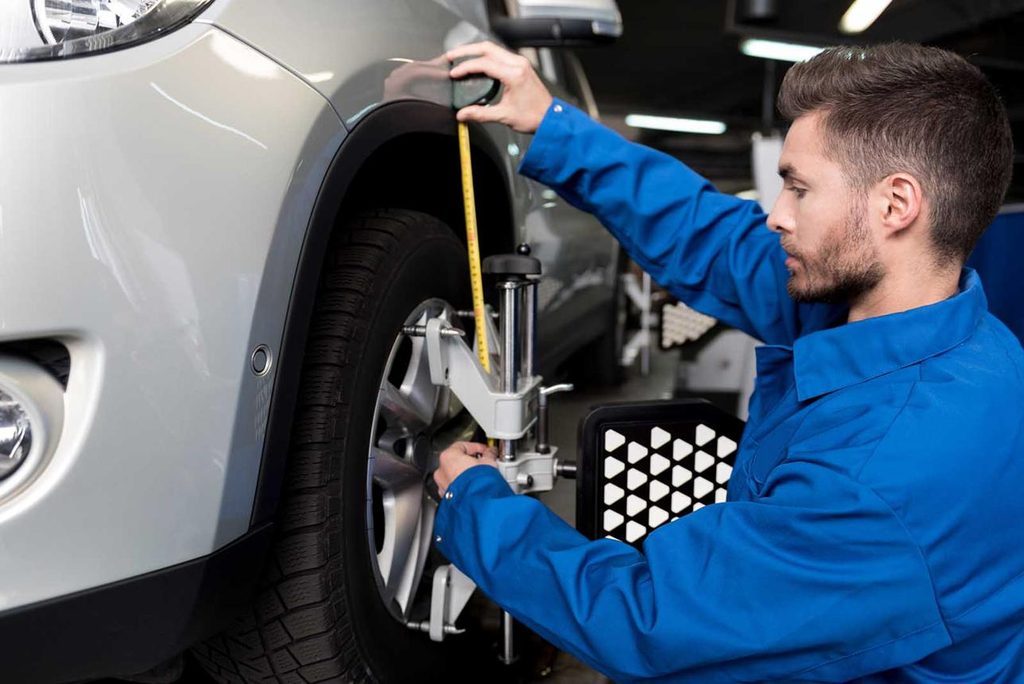
Alignment equipment can measure relevant wheel angles and compare them with the vehicle manufacturer’s specifications.
7. Road testing where appropriate
A road test can help confirm whether the original symptom has been identified and whether corrective work has resolved it.
The goal is not simply to make an adjustment.
The goal is to find out why the vehicle is pulling.
Is It Safe to Drive a Car That Pulls to One Side?
A very slight drift caused by road camber isn’t the same as a vehicle strongly pulling.
Persistent pulling should not be ignored.
It can:
- Make the vehicle harder to control
- Increase driver fatigue
- Contribute to abnormal tyre wear
- Indicate a steering, suspension, tyre or brake problem
Michelin recommends addressing persistent pulling rather than normalising it, particularly when the problem is significant, appears suddenly, or follows an impact
Stop driving and seek assistance if:
- The pull becomes suddenly severe
- A tyre appears damaged or rapidly loses pressure
- Steering becomes difficult or unstable
- The car pulls strongly during braking
- You notice serious braking problems
- There are abnormal mechanical noises combined with poor control
Vehicle control and braking issues should always be treated as safety concerns.
Don’t Assume It’s “Just Alignment”
When your car starts pulling left or right, wheel alignment is certainly one possible explanation.
But it isn’t the only one.
The cause could be as straightforward as incorrect tyre pressure or involve tyre wear, brake drag, steering components, suspension wear or alignment.
That is why diagnosing the symptom before performing repairs matters.
At QuickPro Auto Services, our technicians can inspect your vehicle’s tyres, wheel alignment, steering, suspension and braking systems to determine what’s causing the change in handling.
Whether you drive an everyday car, family vehicle, SUV, commercial vehicle or premium vehicle, identifying the cause early can help protect your tyres and maintain predictable vehicle handling.
Is Your Car Pulling Left or Right?
Don’t keep correcting the steering and hoping the problem disappears.
Visit QuickPro Auto Services for a professional inspection.
QuickPro Auto Services
Al Quoz 3, Dubai
056 805 6000