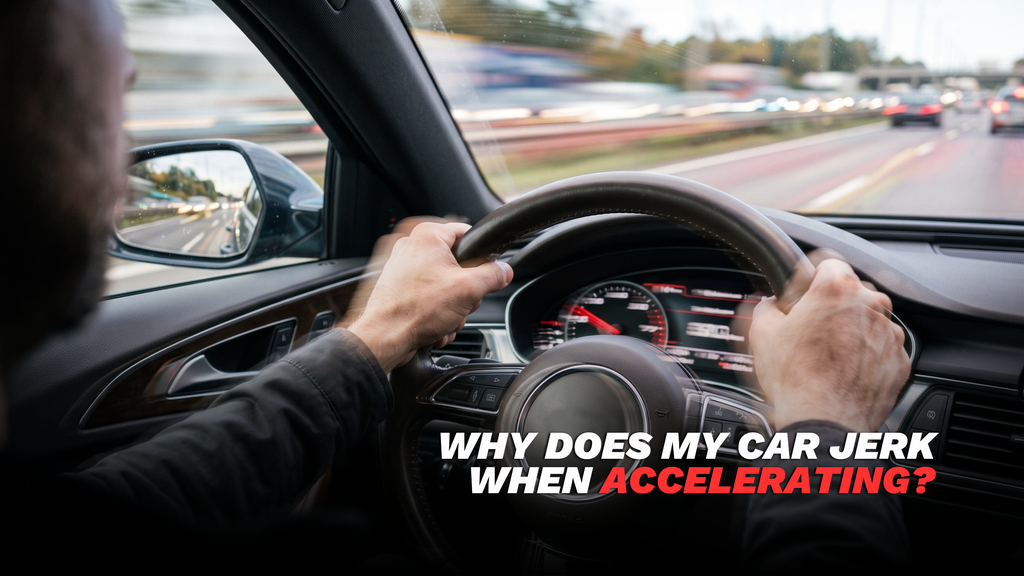
Discover common causes including spark plugs, fuel injectors, sensors, transmission problems and engine misfires, and learn when to get your car checked.
If your car jerks when accelerating, hesitates when you press the accelerator, or suddenly loses smooth power delivery, it is usually a sign that something isn’t working correctly.
The problem may be as simple as a clogged air filter or worn spark plugs, but jerking can also indicate problems with the fuel system, ignition components, sensors, or transmission.
For drivers in Dubai, high temperatures, heavy traffic, frequent stop-and-go driving, and demanding road conditions can place additional stress on these components.
Understanding why your car jerks when accelerating can help you identify the problem early and prevent a relatively small issue from becoming a more expensive repair. Jerking during gear changes, delayed engagement, or slipping can indicate developing transmission problems in Dubai, particularly when the symptoms become more noticeable during acceleration.
Is It Normal for a Car to Jerk When Accelerating?
No. A properly functioning vehicle should accelerate smoothly when you press the accelerator.
A slight hesitation may occasionally occur depending on driving conditions, but repeated jerking, hesitation, or sudden loss of power should be investigated.
You may notice the problem:
- When accelerating from a stop
- At low speeds
- During overtaking
- When driving uphill
- When changing gears
- When the engine is cold
- When the AC is running
- At particular engine speeds
When the symptom occurs can provide technicians with useful information when diagnosing the underlying problem.
1. Worn or Faulty Spark Plugs
Spark plugs ignite the air-fuel mixture inside the engine’s cylinders.
As spark plugs wear, they may struggle to produce a consistent spark. This can cause incomplete combustion and uneven engine performance.
Common symptoms include:
- Jerking during acceleration
- Rough idling
- Difficulty starting
- Reduced engine power
- Increased fuel consumption
- Check Engine Light
Replacing worn spark plugs at the appropriate interval helps maintain smooth combustion and engine performance.
2. Faulty Ignition Coils
Ignition coils provide the electrical voltage required by the spark plugs.
If an ignition coil begins to fail, one or more cylinders may not fire correctly. This condition is commonly known as an engine misfire.
A misfiring engine may hesitate or jerk particularly when additional power is requested during acceleration.
Other symptoms can include:
- Engine vibration
- Rough idle
- Loss of power
- Check Engine Light
- Poor fuel economy
Because several problems can produce similar symptoms, diagnostic testing is important before replacing ignition components. Faulty ignition coils are also a common cause of car engine misfiring, which can result in rough idling, loss of power, vibrations, and noticeable jerking during acceleration.
3. Dirty or Clogged Fuel Injectors
Your engine needs the correct mixture of fuel and air to operate efficiently.
Fuel injectors deliver precise amounts of fuel into the engine. If an injector becomes dirty, restricted, or faulty, the engine may receive an inconsistent fuel supply.
This can result in:
- Hesitation
- Jerking
- Uneven acceleration
- Poor fuel economy
- Rough engine operation
Professional diagnosis can determine whether the injectors require cleaning, repair, or replacement.
4. Restricted Airflow to the Engine
Your engine also needs a steady supply of clean air.
A clogged engine air filter can restrict airflow and affect the engine’s air-fuel balance.
Dubai’s dusty environment makes air-filter inspection particularly important because airborne sand and fine dust can accumulate faster than in less demanding climates.
Depending on the vehicle and severity of the restriction, you may notice reduced performance, sluggish acceleration, or increased fuel consumption.
Regular air-filter inspections help maintain efficient engine operation.
5. Faulty Engine Sensors
Modern vehicles rely heavily on electronic sensors to manage engine performance.
Important sensors monitor factors such as:
- Airflow
- Oxygen levels
- Throttle position
- Engine temperature
- Intake pressure
If one of these sensors sends incorrect information to the engine control unit (ECU), fuel delivery or ignition timing may be affected.
The result can be hesitation, irregular acceleration, poor fuel economy, or a Check Engine Light.
This is why modern vehicle diagnosis often requires more than a mechanical inspection. A professional diagnostic scan can identify stored or pending fault codes and provide valuable information about sensor performance.
6. Transmission Problems
Not every acceleration problem originates from the engine.
If your vehicle jerks particularly when changing gears, the transmission may require attention.
Possible causes can include:
- Transmission fluid problems
- Worn internal components
- Sensor or electronic faults
- Gear-shifting problems
- Clutch-related issues in applicable vehicles
You might also notice delayed gear engagement, slipping, unusual noises, or inconsistent gear changes.
Transmission problems should be investigated early because continued driving can increase damage and repair costs.
7. Fuel Delivery Problems
If the engine isn’t receiving enough fuel when you accelerate, the vehicle may hesitate or jerk.
Potential causes include problems involving the:
- Fuel pump
- Fuel filter
- Fuel pressure
- Injectors
- Fuel-system sensors
Fuel-delivery issues can become particularly noticeable when the engine requires more power, such as during hard acceleration or uphill driving.
A proper diagnosis is necessary because replacing components without identifying the actual cause can result in unnecessary repair costs.
8. Engine Misfiring
Engine misfiring is one of the most common explanations for jerking during acceleration.
A misfire occurs when combustion doesn’t happen correctly in one or more cylinders.
Potential causes include:
- Spark plugs
- Ignition coils
- Fuel injectors
- Air-fuel mixture problems
- Sensor faults
- Mechanical engine problems
Some misfires are immediately noticeable, while others initially appear only during acceleration.
Ignoring persistent misfires can affect fuel economy, engine performance, and other components such as the catalytic converter.
Why Does My Car Jerk Only at Low Speeds?
If your vehicle jerks mainly at low speeds or while moving through traffic, possible causes include transmission behaviour, ignition problems, throttle-related faults, or inconsistent fuel delivery.
Stop-and-go driving can make these symptoms more noticeable because the vehicle repeatedly transitions between idling, low-speed acceleration, and gear changes.
Rather than assuming the transmission is responsible, the vehicle should be diagnosed properly to determine whether the issue originates from the engine, transmission, or electronic control system.
Why Does My Car Jerk When I Press the Accelerator Hard?
Hard acceleration places greater demand on the engine.
The vehicle suddenly requires more:
- Fuel
- Air
- Ignition performance
- Transmission response
A component that operates adequately during gentle driving may struggle under increased load.
For example, a weak ignition coil might appear normal while cruising but cause a noticeable misfire during hard acceleration.
This is another reason why describing exactly when the jerking occurs can help technicians diagnose the problem.
Can Dubai’s Heat Make the Problem Worse?
Dubai’s extreme temperatures don’t necessarily cause every acceleration problem, but heat can place additional stress on vehicle systems.
High temperatures can affect:
- Cooling system performance
- Batteries and electrical systems
- Rubber components
- Engine operating conditions
- AC load
- Transmission temperatures
Existing weaknesses can therefore become more noticeable during Dubai’s hotter months.
Regular preventive maintenance becomes particularly important for vehicles driven daily in these conditions.
Can You Keep Driving If Your Car Jerks When Accelerating?
Occasional mild hesitation should still be inspected, but severe or persistent jerking requires more immediate attention.
Avoid continuing to drive if the problem is accompanied by:
- Flashing Check Engine Light
- Significant loss of power
- Engine overheating
- Burning smell
- Heavy vibration
- Transmission slipping
- Unusual mechanical noises
A flashing Check Engine Light in particular can indicate a serious misfire that may damage the catalytic converter.
Why Proper Diagnostics Matter
Because so many different problems can cause a car to jerk, guessing the cause can become expensive.
Replacing spark plugs won’t solve a faulty fuel injector. Replacing transmission components won’t fix an engine misfire.
A proper diagnosis may involve:
- Computer diagnostic scanning
- Fault-code analysis
- Ignition system testing
- Fuel-system inspection
- Air-intake inspection
- Transmission evaluation
- Road testing
Finding the root cause before replacing components helps avoid unnecessary repairs.
How Can You Reduce the Risk of Acceleration Problems?
Preventive maintenance can reduce many of the problems that cause hesitation and jerking.
Follow your vehicle manufacturer’s recommended maintenance schedule and pay attention to:
- Engine oil changes
- Spark plug replacement intervals
- Air-filter condition
- Fuel-system health
- Transmission servicing
- Cooling-system condition
- Dashboard warning lights
Most importantly, don’t wait for a minor symptom to become severe before having your vehicle inspected.
Get Your Car Checked Before a Small Problem Becomes a Major Repair
If your car jerks when accelerating, there isn’t one single component that can automatically be blamed. The problem could involve ignition, fuel delivery, airflow, sensors, the transmission, or the engine itself.
Accurate diagnosis is therefore the first step toward an effective repair.
At QuickPro Auto Services, we provide professional vehicle diagnostics, servicing, and mechanical repairs for everyday cars, family vehicles, SUVs, and premium and performance vehicles. Our technicians use advanced diagnostic equipment to identify the underlying cause rather than simply replacing parts based on symptoms.
If your vehicle is hesitating, jerking, or losing power during acceleration, getting it checked early can help prevent further damage.
📍 QuickPro Auto Services – Al Quoz 3, Dubai
📞 056 805 6000